Tuesday, February 11, 2014

The war on science's first casualty: Our quality of life

image by Nickio Benvolio

I recently saw a story of a company that had an issue with employee complaints about air quality.  The likely culprit was a sewage backup that once fixed, the air quality improved.  Unfortunately, the perception became that the air was bad, and without any evidence to the contrary, the label stuck.  The company called in an air quality expert with limited technical knowledge of buildings who found any number of possible causes, and recommended huge expenditures of energy and material to solve a "potential" problem.  In analyzing the problem, engineers arrived at a simple solution, but the company responded that the resolution was not "visible" enough.  The people in the area had it in their minds that a problem existed, and no scientific explanation would satisfy them.

We live in an age of paradox and irony.  Evolution, climate change, and conception remain hot topics of debate in the public sphere.  However, from the point of view of the scientific community, debate about relatively settled science detracts from implementing smart policy to improve quality of life related to the issues.  The lack of understanding of even basic science among the populace in general and political/business leaders in specific, hinders the implementation of sensible policies to make our life better.

As we survive what hopes to be the last sub-zero day of the winter (my Weather Channel forecast has a 40+ degree day on the horizon!), no issue has brought more attention to this than winter 2013-14 in the US.  The scientific understanding of climate change predicts that circumstances like the extreme cold of this year can and will happen.  However, news coverage and political discourse points to the weather and calls any form of climate mitigation a fools errand.

Over 95% of the scientific community agrees that these extreme weather events (don't tell the people in Australia or Alaska that we have returned to normal weather) will continue and result from human intervention with our atmosphere.  We cannot get 95% of economists to agree that unfettered, free market capitalism is the best way to manage an economy, but almost every climate scientist agrees our world is changing, and just slightly fewer agree that we have caused it.  The only explanation for this comes from a deliberate devaluing of science in the public sphere.

Science values questioning.  Using new knowledge to challenge old beliefs has great value.  That said, our current approach to science and policy is to spend most of our resources challenging science and less implementing solutions consistent with accepted science.  The more fronts we have to wage this battle, the less likely we are to find solutions.  We need to shift that balance so that we put more effort into finding solutions and less into questioning.  As a side benefit, should nature prove us wrong, the act of finding solutions usually produces tangential results that have value.

I do not recommend the acceptance of every crackpot theory.  Science already has a process to weed out bad ideas, and focus on valuable ones.  When that process produces consensus, then we need to have a mechanism that allows for debate on solutions without having to reinvent the wheel each time.  If we cannot find a way to do this, to avoid the constant war on science, we place ourselves in greater jeopardy.


Monday, February 10, 2014

Who will keep the water flowing, bridges standing, and buildings working in the US?

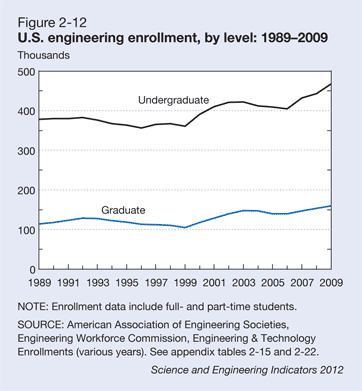
Two of my children have the same high school math teacher that I had.  At one parent night, he spoke about how students that successfully completed the math program at the school went on to top colleges, and into good careers like business and law.  Noticing me, he took a bit of a departure from his standard monologue to lament that in my day, the students in the program would mostly go into engineering, science, and medicine.  In fact, the top three students in my year became a doctor, mathematician, and mechanical engineer, respectively.  My former teacher's lament is well-founded.  Until recently, the number of students enrolled in science and engineering degrees had not kept pace with the increase in population, and of that enrollment, a larger percentage each year come from other countries.  Additionally, the type of engineer matters, and we will soon reach a crisis that has no plan B.

In the US, we have 450,000 licensed professional engineers (about 0.1434% of population).  These engineers hold the legal responsibility for the design and performance of buildings, infrastructure (pipelines, roads, water treatment, etc.), and technology (cars, computers, etc.).  Every day, almost every activity we pursue involves the work of an engineer.  Over the coming years, as our infrastructure continues to crumble and need repair, as we need to rehabilitate our buildings and build new ones for a population that will grow by thirty percent over the next thirty-five years, and as we need to solve the problems of climate change and resource distribution, we will need to add between 2,500 and 3,500 licensed engineers each year to keep pace with population growth and expanding needs.  This need comes amidst three challenges: aging population of existing engineers, increased opportunity abroad for foreign-born engineers, and uneven distribution of engineers by discipline.

Assuming a population distribution similar to the population as a whole, over the next thirty-five years, an average of around 10,000 licensed engineers will retire each year.  At the same time, each year we graduate between 70,000 and 90,000 engineers from the nation's universities.  On the surface, this would suggest we have more than enough capacity.  However, on average, only twenty percent of graduate engineers ever obtain their license, and therefore the legal authority to certify designs.  Between the natural attrition to other professions, the difficulty in obtaining a license (which requires passing two exams and attaining four years experience in most states), and the declining pay relative to other professions, we produce between 14,000 and 18,000 licensed engineers each year.  Additionally, until the last several years, that number had declines steadily since the early 1980s, and if we do not maintain, we will find ourselves scrambling to fill vacancies.

Even among these 14,000 to 18,000 licensed engineers we produce each year, the changing global landscape creates a pressure on the American marketplace.  Thirty years ago, between three and five percent of graduates from engineering programs lived abroad, and many of them took jobs in the US after graduation.  In 2008 through 2012, that number grew from sixteen percent to almost twenty-five percent.  Add to this the opportunity to develop new cities in China, India, and the Middle East, and those foreign nationals who used to attend our top programs then stay now attend and go back to their country.  If the trend continues, within a decade as many as one-third of the engineers graduating each year will come from abroad and return there.  That reduces our numbers to between 9,500 and 12,000...not enough to keep up with the 13,000 we need at a minimum to keep pace.

Lastly, as with most needs in the labor market, specific skills matter.  The growth in engineering over the last twenty years has come from biomedical engineering and computer engineering.  Traditional engineering disciplines such as civil, mechanical, electrical (non-computer), and chemical have remained flat or slightly declined.  This means that although in total number we may come close to replenishing our labor force, as those who design and maintain our roads, buildings, and infrastructure retire, we will have fewer ready to take their place.  These foundations of our civil society get taken for granted, but when they start to fail, the cost to our economy and our security will be great.

In some ways, market forces can solve the problem, but we need even more than the hope of capitalism.  As the number of engineers decline, and need remains, this should put an upward pressure on salaries and increase the desire of high school graduates to enter traditional engineering.  We already see this in mining engineering which makes as much as twice other disciplines at entry level because the demand is high and supply small.  We need to do more as a society, however.  The risk of salaries not increasing enough, fast enough is too great.  We need to encourage more young women and minorities to enter science and engineering to make up for declines among other demographics.  We need to restore science and engineering's prominence, both financially and socially.  We need to demand more technical knowledge across our economy.  The great capitalists of the 19th century came from the technical class, not a class created in and of itself to manage.  We see this resurgence in Silicon Valley, and we need to restore it to other sectors of our economy.

My children will not go into engineering, and neither will most of their classmates.  If we do not do something as a society to change that, all the freedom and capital in the world will not prepare us for the consequences.

Thursday, February 6, 2014

Friday Five: February 7, 2014

Earlier this week, I posted images from some freshwater sources that we humans have all but dried up.  In California, some communities find themselves on the verge of that catastrophe.  What's the old saying? We can live 3 months without food but only 3 days without water?
California drought: 17 communities could run out of water within 60 to 120 days, state says
"Most of the affected water districts have so few customers that they can't charge enough money to pay for backup water supplies or repair failing equipment, leaving them more vulnerable to drought than large urban areas.
The state health department compiled the list after surveying the more than 3,000 water agencies in California last week. The list will be updated weekly, Mazzera said."

Imagine you desperately want to take your family to a cottage near the lake, but you live in the city.  You cannot get there - at least until recently - without using a vehicle powered by refined crude oil.  That reliance on crude means that a refinery had to process it and deliver it to your local gas station.  Now imagine that the train carrying that crude to your local refinery spilled a load of that crude into the lake adjacent to the cottage...still want to go?
Communities along rail lines worry about explosions
"Initially, when crude by rail got started, it occurred in the Bakken play in North Dakota. The initial idea was to use rail to get crude to market simply to bide the time until pipelines were built out with enough capacity. But once crude oil got going, the commodity traders and the exploration and production companies realized that rail gave them faster transit times, the ability to ramp up more quickly than pipelines, and the ability to take the crude oil to different destinations where a higher price could be received for those barrels."

Not that accidents associated with fossil fuel transfer and processing ever occur, especially never involving water.
Tons of coal ash spill into North Carolina river
"'It's the latest in a series of spills and leaks into waterways, including drinking water reservoirs and upstream from drinking water uptakes, and groundwater,' Frank Holleman, a senior attorney at the center, said in statement. Holleman represents several environmental groups who have taken Duke Energy to court over the storage of coal ash, a byproduct of coal-fired energy plants."
West Virginia spill criticism grows amid new fear over tainted water
"Dr. Rahul Gupta, director of the Kanawha-Charleston Health Department, the largest in West Virginia, said in an interview Friday that the water can't be considered completely safe because scientists don't know the possible health effects of exposure to the chemical. He said officials have confused the 300,000 residents whose water was tainted by first declaring it safe, then resuming distribution of bottled water Thursday."

Every once in a while, the markets get it right.  Pharmacies can make more money if they offer other well-being and urgent care services, but most - if not all - health providers will not partner with a pharmacy if that business sells...how shall we say it...the leading cause of human-caused death.  I fear that I heap praise on an entity for following common sense, but given the lack of common sense over the last thousand years or so, it merits a toast to CVS for leading the way.  I know you did it for long-term financial reasons, but that does not mean you did the wrong thing.
CVS takes a stand, halts tobacco sales
"Still, as both CVS executives and industry analysts noted Wednesday, the move will make it easier for the company to form partnerships with doctors, hospitals, and insurers and allow the chain to expand its brand as a health care provider — a business expected to become more lucrative as the population ages and the new federal health care law increases demand for basic services such as checkups."

The move by CVS is just one of several things that give me hope that we will get this thing solved.  And if a sustainable future involves jetpacks...all the better!
Future near perfect: How humans can still save the day by 2050
"Key features of this world, fingers crossed, include: an economy almost completely powered by renewable energy; a global population stabilized around 9 billion people; food systems based on community use and closed-loop systems; inefficiency in water management all but eliminated thanks largely to drip irrigation and rainwater capture; comprehensive preventative healthcare with a side of nanotechnology; worldwide sharing economies; and personal jetpacks."

Happy Friday!


A year in green tech: Constructed wetlands

A common theme among practical environmentalists centers on the concept that as humans we have no right to shift the consequences of our actions onto another human being.  We point out the injustice of using electricity to maintain a high quality of life, but allowing those who live near coal electricity plants to bear the brunt of the asthma and heart disease that comes from burning coal for energy.  Or letting the residents of West Virginia deal with the water contamination from chemicals associated with coal processing.  Or sitting back while the residents of Colorado wonder if their water is safe to drink after wastewater pits from fracking operations were washed out by floods.  Even with climate change, although it equalizes the impact some through extreme weather events and sea level rise along coastal communities with typically high property values, poorer nations like the Maldives (which just recently grew out of the "least developed country" status in 2011) must deal with the threat that their entire island nation will end up underwater, requiring the relocation of the entire population.  In example after example after example, one segment of our society - and most of the time the poorest and most powerless among us - has to deal with the negative impact of our energy use, while most of us in the highly developed world enjoy only the benefits.

Nowhere do we accept this state of affairs more than with our human waste.  Other than improvements in the medical field associated with child birthing, no single application of technology improved human health and lifespans more than indoor plumbing and wastewater treatment.  Diseases like cholera that commonly affected US urban areas in the late 19th and even early 20th centuries, no longer exist on a mass scale in this country.  When plumbers exclaim that they "protect the health of the nation", that is not over-hype.  Because of this, we accept the entire process as necessary, and even the staunchest environmentalists pay no mind to the process of accumulating and treating that waste.

In Chicago specifically, our "water cycle" involves us draining water from Lake Michigan, using it in our homes and replacing it with various forms of human and chemical waste, then collecting in in large wastewater treatment facilities.  These facilities then remove the solids, phosphorus, nitrogen, and other chemicals, then release that resultant water (also called effluent) into the systems that feed the Mississippi River.  Our output - which also includes almost all of the rainwater that falls on Chicago - travels downstream to the river communities of the Mississippi and gradually to the Delta.  There, it contributes to increased flooding and eutrophication, the process by which a freshwater plume overtakes the saltwater and kills or displaces the naturally occurring ecology of the Caribbean. In this process, we consider the effluent of our treatment plants acceptable to drink, but not by us.  Even these treatment plants have their issues.  The processing of so much human waste produces air quality issues for the communities that surround them.  We all enjoy the increased health benefits of waste management, but only these communities have to deal with the smell.

What if the residents of a block or community had to deal with the odor associated with treating their waste?  Or had to drink the output of the treatment facilities that processed the waste?  Would we have a different approach?

Constructed wetlands treat wastewater while recognizing the importance of placing the consequences of a process on those who benefit from the improved quality of life.  These man-made wetlands provide the benefits of natural wetlands - water purification, flood mitigation, habitat provision - but with the specific purpose of filtering and purifying wastewater from a specific building or community.  The best applications construct them above the water table of naturally occurring wetlands or ground water so that the effluent or outflow naturally finds its way to the local watershed (or land area physically connected to a water source, i.e. Chicago sits mostly in the Lake Michigan watershed) for recycling into the local ecology.  Installing them in this way also keeps them from flooding and prematurely releasing any harmful waste into local streams, rivers, and lakes.

The process works on some basic, natural principles.  The most simple comes from taking a water flowing at measurable velocity out of a pipe and slowing it by spreading it out over a large area.  That action uses the Bernoulli principle to drastically slow the water, which then allows the solids to naturally settle into the wetland.  The wetlands contain plants specifically chosen because of their desire for the likely chemicals present in the waste.  Plants that absorb large amounts of nitrogen, phosphorus, or other chemicals will render the chemical inert or beneficial, cleansing the water in the process.  After working its way through the constructed wetland, the water reaches a level of quality acceptable to return to a natural water source to recycle into our drinking water systems.

Constructed wetlands provide the added benefits of beautifying the local area, and improving the local ecology.  Planted areas lower ambient temperatures, creating more comfortable climates and reducing cooling loads in buildings.  The plants provide a habitat for nature that increases the local biodiversity.  The plants within these systems provide a colorful contrast to "pavement and manicured lawn" look of most urban areas.  Although they work well as somewhat traditional surface-flow wetlands where one can see the water, for areas where people will likely encounter them, a sub-surface-flow application can maintain a typical soil look at the surface with the filtering processes happening out of sight.

I do not believe that most of us, when presented with the facts of a situation, knowingly desire to degrade the life of another to improve our own.  Our natural instincts, however, include both self preservation and ignorance of that which we cannot see.  This combination allows us to accept the damage associated with our choices as long as our quality of life remains high.  As we evolve in this thinking, technologies like constructed wetlands offer us the opportunity to both maintain a high quality of life and accept the consequences of our actions.

P.S. For those that are interested, there is a version of these systems where instead of using land area to construct a wetland, we use tanks in a greenhouse or other indoor environment to accomplish the process.  These are normally prohibitively expensive, and the efficacy still needs improving.  For those who would like more information, follow this link to an example of such a system.

Resources:
EPA A Handbook of Constructed Wetlands
EPA Constructed Treatment Wetlands

Tuesday, February 4, 2014

Flashes: February 4, 2014

Those who do not learn from history are doomed to repeat it...those who do learn from history are doomed to watch other people repeat it.

Change in water levels for the Aral Sea between 1989 and 2008


Change in water levels for Lake Chad from 1963 to 2007


Change in water levels for Lake Mead from 1984 to 2007


Is it the speed or the ingredients that drive us to fast food? And does the Farm Bill enable our addiction?

US News & World Report
I had two encounters with convenient food (including both junk food and fast food) yesterday, neither of which...thankfully...resulted in my consuming it. First, at a regular morning meeting in my office, someone had brought donuts, ostensibly as a gesture of generosity and camaraderie.  The second encounter happened as I left the train station and caught sight of the convenience store stocked to the brim with a variety of snack foods but no fruits or vegetables.  In each case, I wondered what would happen if the offerings consisted of foods considered "healthy" instead of the sugar/fat/salt laden food stuffs.  Would the sense of enjoyment or convenience be the same?

This question rings true now because of the current debate over the role of government in our food economy as reflected through the Farm Bill that the Senate will pass today.  This bill contains the subsidies and economic protections to farmers who grow certain types of "necessary" food products, as well as supplemental nutrition assistance to people who cannot afford to purchase food.  The latter has sparked significant debate, and will likely result in cuts to the program and more people ending up going hungry in this country.  However, the former drives - at least to a point - the prevalence of unhealthy food in our society.  The subsidies for corn and soy drive the prices down, and create a market for secondary products like high-fructose corn syrup and soy lecithin.  Use of these additives allows for the cheap production of vast amounts of snack products, and with large supply comes low prices.  When grabbing a package of Twinkies costs less than an apple, the economics win out.

But can that really be all there is to it?  Would repealing the subsidies, or switching them to fruits and vegetables change the dynamic?

Although part of me would like to believe that given the choice between an apple and a package of Twinkies, that most would choose the apple if it cost less, I do not believe it to be that simple.  The popularity of these types of junk foods comes not just from their price, but the way they play on our base desires for sugar, fat, and salt.  People can develop sugar addictions just as easily as other forms of addiction, and with the same outward signs.  An apple has sugar in it (in the form of fructose), has a strong convenience factor, and even the organic varieties compete economically with other snacks.  Yet how many people pass over the apple for a package of Oreos, or a bag of Doritos?

In this context, I wonder how much success a line of new vending machines will find.  In concept, the easy dispensing of a salad should take care of the convenience factor, however at around $8 per salad, the economics does not favorably compare with the $1 menu at fast food locations.  But even if the Farm Bill removed the subsidy for junk food, and replaced it with a subsidy for fruits and vegetables, would that change anything.  A nation that still has binge drinkers,  chain smokers, and drug users after years of solid evidence shows the dangers of all of these, gives us little hope that even economics will drive our decisions.

In the end, we will have to change if we want to avoid the catastrophe ahead.  Looming costs for treating an America that is heavier and less healthy weigh heavily on our future economic forecasts.  To mitigate this, we need to change policies like providing subsidies that promote junk food, and instead switch them to subsidies for healthy foods.  More importantly, we need to work on changing our approach to business and our approach to personal responsibility.  Although this presents a chicken and egg, if industry can find alternative, more healthy ways to market our snacks to us, and we can respond by consuming less of the unhealthy and more of the healthy, we can change the market and flip it to one more dependent on healthy choices.

We no longer buy gasoline or paint with lead in it, building products with asbestos, or aerosol cans with CFCs.  We have shown the ability to make changes that improve our health.  Food choices may be too personal for us to make the leap...but it is in our best interest to try.

Monday, February 3, 2014

Access to the future, or access to your wallet

Over the past decade, the amount of solar power installed has increased geometrically.  From large-scale solar power to distributed panels installed at individual residences, total installed capacity has tripled in the last three years and will double again in the next two.  For the environment, we can only hope that this pace continues and even accelerates.  For utility operators, they worry that as more homes and buildings install solar, they will see greater instability.  These operators have fixed costs that they normally pass onto customers based on the amount of energy they consume, but when renewable energy customers consume a net of zero, or near-zero, they disproportionately pass the costs on to non-renewable energy customers.

GTM Research
The solution from utility operators takes the form of an access fee. Each renewable energy provider - be it a large-scale provider or individual homeowner - pays a fee to connect to the grid.  Solar customers argue that this fee will stifle adoption of solar energy. In addition, solar advocates argue that utility operators want the fee only to milk their existing conventional assets instead of to maintain or improve the grid. As with every argument by those on opposite sides who stand to gain financially, the truth sits somewhere in the middle.

Utilities do have sunken costs in assets that we still need.  Some of these assets provide power, and some provide distribution of electricity. The distribution assets benefit both the renewable and non-renewable sources providing an additional benefit as a place for renewable energy systems to deliver energy during times of over-production as we await the development of storage technologies.  The power generating assets, on the other hand, serve no long-term benefit to us, and as such, should not receive subsidy from those who no longer desire them.

One way to reach the compromise needed to transition from dirty energy to clean energy involves allowing utilities to charge an access fee, but vary it based upon the circumstances. If a customer installs their own solar energy (or other renewable energy) system, then the utility gets a moderate fee if, and only if, the customer sells back to the grid in lieu of storage. If a customer goes "off-grid" entirely, they have no fee. However, if the utility installs the renewable energy on the customer's building, the customer pays a higher fee.  In addition, the utility can charge the customer for the energy they receive for a number of years until they recover their first costs using a mechanism titled On-Bill Financing (OBF). OBF allows customers to receive the benefits of clean energy and energy efficiency without having to pay large up-front costs.  These benefit the utility because they provide a stable, long-term funding source.

Utilities demand full compensation for renewable energy customers, but then refuse to pay the full cost of their activities - notably avoiding the costs associated with health concerns and property damage associated with electricity production. Although we need to allow utilities time to transition from energy producers and grid managers to their role in a future that relies only on clean energy, they need to recognize the hypocrisy of demanding full compensation when they do not take full responsibility.  Those who choose to install solar energy on their buildings need to pay if they use the utility grid in any way, but renewable energy customers do not need to pay at the same level as those who still use conventional, damaging assets. Those who use damaging power should pay for it, and as those costs rise, we will see the true value of clean energy. Utilities can participate in the solution, or they can continue to find more ways to get customers to pay.