America established most of its infrastructure and set most of its lifestyle (not necessarily equal to quality of life) expectations in an era of limitless energy. Now that we realize not only will our current forms of energy be exhausted in most of our's lifetimes, but that even consuming a portion of it will irrevocably change our planet, it no longer seems as exciting, safe, or cool to do what we once did.
Have the suburbs hit a dead end?
"The suburbs were a great idea that worked really well for a long time, but they overshot their mandate. We supersized everything in a way that led many people to live far away from where they needed to be and far away from their neighbors, and that has far-reaching implications, no pun intended. People have turned away from that kind of living. Add in the demographic forces that are reshaping our whole population, and the result is a significant shift. Census data shows that outward growth is slowing and inward growth is speeding up."
For something to have "scientific proof", we must first identify correlation, establish the science of causation, then repeatedly replicate the causation under the assumed scenario. Using this as a guide, we are well along the path to proving that processed foods - as currently engineered - do more harm than good.
Scientists officially link processed foods to autoimmune disease
"The team from Yale University studied the role of T helper cells in the body. These activate and ‘help’ other cells to fight dangerous pathogens such as bacteria or viruses and battle infections.
Previous research suggests that a subset of these cells – known as Th17 cells – also play an important role in the development of autoimmune diseases.
In the latest study, scientists discovered that exposing these cells in a lab to a table salt solution made them act more ‘aggressively.’
They found that mice fed a diet high in refined salts saw a dramatic increase in the number of Th17 cells in their nervous systems that promoted inflammation.
They were also more likely to develop a severe form of a disease associated with multiple sclerosis in humans."
Although we do not yet know that the levels of radiation released into the ocean will cause issues - for we should remember that we have some level of radiation naturally occurring all the time - the larger concern comes from the continued inability to contain. The safety of nuclear-fuel generated energy comes from the assumption of perfection in operations. Without perfection, the risks escalate to an unacceptable point. Especially when we know now that other forms of energy generation that cause less harm also cost less.
New leaks into Pacific at Japan nuclear plant
"The water contains strontium and cesium, as well as tritium, which is considered less dangerous when released into the ocean. Despite increasing alarm among regulators in recent weeks, the plant’s operator says it does not yet pose a health threat because levels of the contaminants are still very low in the open ocean, beyond the plant’s man-made harbor — a contention even critics support."
I will continue to point stories like this out until the point comes across: our economy is man-made, and whatever we deem important will be cost effective. Incumbents in the marketplace can always rig the system in their own favor, unless we step in and stop it. It has nothing to do with theoretical economics or "free markets", its just greed and self-preservation and our system encourages it. It also has no connection to natural law, which should frighten all of us.
FirstEnergy paid $100 million too much for renewable power
"The Public Utilities Commission of Ohio has ruled FirstEnergy overcharged its Ohio customers by $43.3 million for electricity generated by wind and solar. A consultant to the commission found overcharges of more than $100 million. "
For those in the Midwest who see this as just another story of how "the coasts" are doing, the Great Lakes present a huge opportunity for offshore wind. If these developments move forward, we could see offshore wind on the great lakes by 2020 to 2025. If done right, that would mean greater opportunity to rid our local grid of harmful forms of electricity generation.
Deepwater wins first auction for US offshore wind lease
"The project may cost as much as $5 billion, including about $1 billion for transmission systems to deliver power to shore, Deepwater Chief Executive Officer Jeff Grybowski said yesterday by phone. He plans to market the project’s electricity to potential buyers in Long Island, Rhode Island, Massachusetts and Connecticut.
'We’re hoping that this year and next year we can start putting the power purchase agreements together,' Grybowski said. The project will likely be built in phases with 200 megawatts to 400 megawatts of generating capacity, he said. 'It’s unlikely we would try to sell the power all at once.'"
Happy Friday!
Friday, August 9, 2013

Thursday, August 8, 2013
When you rob Peter to pay Paul, what happens when Peter is REALLY angry and powerful?
We all love low prices. If we can get something for nothing, all the better. If something does not keep dropping in price, it becomes fodder for politicians to rail against the party in power as not doing enough to keep prices down.
We often - if not always - miss the point.
Prices are a relative indicator of priorities. When we get caught up so much in the "something for nothing" game, we forget that what we pay for something determines the value and incentive someone else has to produce that good or service. (Just try to find a high-quality, full-feature VCR these days.) Typically, in theoretical economics, the price of a good or service depends only on the availability of the item (supply) and the desire of the public for it (demand). When supply is high and demand low, prices drop, and vice versa when demand is high and supply low. On paper, this works well at allocating consumable or finite resources (like food and time respectively), but in the real world, we manipulate prices in so many ways that disrupt the ideal marketplace, often with disastrous results.
One need look no further for an example of this than US food and agriculture policy for the last seventy years. After the Depression, and the devastation of rural America during the Dust Bowl of the first half of last century, we made a social compact to support farming with crop insurance, infrastructure support, and - unfortunately - subsidies. Let me quickly state that reducing the risk associated with farming, especially for independent and small farmers who should make up the entirety if not the majority of farming in this country, is a good thing. However, the way we have subsidized it has had disastrous results for our health and our way of life.
The Union of Concerned Scientists just released a report (with a catchy video) detailing the cost to Americans in lives lost and medical cost escalation due to the skewed policies of farm subsidies and crop insurance in the US, and the behaviors that we have adopted readily because of the distortions in the market. Because of the cost and availability of fruits and vegetables relative to subsidized crops such as corn and soybeans (and their byproducts), Americans eat less than half of the fruits and vegetables necessary to maintain health. Meanwhile, overproduction of these "staple crops" results in the desire to find as many ways as possible to get the product into the marketplace. Anytime a cheap, subsidized product can replace a more expensive, unsubsidized one, the market will make sure it happens. Thus we have high-fructose corn syrup, soy lecithin, and cheap junk food from various forms of processed soy and corn finding their way into our food system. (The fact that 90% of this soy and corn comes from genetically modified sources is a topic for another day.) From the report:
In addition, policy makers should remedy flaws in current
farm policy that restrict the supply of domestically
grown fruits and vegetables in more overt ways.
Currently, farmers who receive subsidies to grow commodity
crops such as corn are prohibited under those
subsidy programs from planting any acreage with
fruits and vegetables, except under certain conditions.
The removal of such planting restrictions would be
an important step toward facilitating more competitive
market conditions for healthful foods.
The federal crop insurance program is yet another exampleFederal farm policy is not the only change needed, we must all make smarter choices as well.
of where farm policy reform is urgently needed.
The USDA-administered and -subsidized insurance
program is oriented toward farmers who grow a handful
of subsidized commodity crops, including corn,
soybeans, and cotton. Many fruit and vegetable farmers,
particularly those growing a variety of crops, do
not have access to adequate insurance. This omission
places these farmers at a disadvantage, as the
lack of crop insurance, particularly for those on smaller
farms, often translates into difficulty in obtaining
needed credit (O’Hara, 2012). Instead, a USDA-backed
insurance policy covering all the crop and livestock
revenue that a farm generates in a year (in contrast
to crop-specific insurance policies) should apply. The
new policy could provide risk management to diversified
fruit and vegetable farmers, thereby helping
them supply more local markets and consumers with fresh
and affordable produce.
The savings associated with major shifts in policy and behavior combined is huge. The authors of the report calculate that the savings in medical care and treatment resulting from increasing fruit and vegetable intake by one more serving a day would be $5 billion a year today and $13 billion a year in 2030. Increasing just to the recommended level of daily fruit and vegetable intake would mean a savings of $17 billion a year today and $54 billion a year in 2030. That just represents the cost savings from increased cardiovascular disease relative to a baseline of healthy eaters. The greater cost to society comes from the early deaths associated with this subsidized lifestyle of unhealthy eating. Again, the report:
While these medical cost savings are significant,The report acknowledges that setting a value for human life in an economy has its pitfalls. We do not think of people's lives in terms of the value someone else would pay for them, but the report does look at the costs people will pay to reduce their risk of death. Given that valuation, the report estimates the value of the saved lives from improved diet come in at around $11.4 trillion.
they are dwarfed when compared with the value of
increased longevity that would result from a population-
wide dietary shift. Assuming, as above, that
premature deaths from heart disease and stroke are
proportional to the incidence rates of these diseases,
we estimate that a sustained daily per capita oneserving
increase in fruit and vegetable consumption
would prevent 30,301 premature deaths annually.
And if Americans ate fruits and vegetables at the
Guidelines’ recommended levels, we could save
127,261 lives each year.
Yes. With a "t". Trillion.
This does not account for the value each person adds to the economy, nor the improved quality of life of both the saved lives and the rest of the Americans who eat a healthier diet. This just values the cost savings from treating one range of diseases associated with unhealthy eating and the reduced risk of death for the lives saved. With $11.4 trillion as a starting point, think of the impact if we made even some of the simple changes outlined in the report.
We can go on believing that a working economy will reflect our priorities and give us the right things at the lowest price, but the opposite is true. We must strive to make sure our purchases in the economy reflect our values. We must also make sure that our lawmakers reflect these values in the policy decisions they make, and that those decisions contribute to our quality of life - not damage it. We can celebrate low prices for basic needs, and ignore the fact that the proliferation of low cost "staples" means higher costs and shorter lifespans in the future.
But nature has a way of ignoring our man-made economy and our political rhetoric. If something is unhealthy, no amount of political speechmaking or low prices will make it not so. It is up to each of us to make our economy reflect our values...and to make our economy save life instead of wasting it.
Wednesday, August 7, 2013
Flashes: August 7, 2013
There ought to be a law:


- That closes down any energy company that pursues a gag order against anyone (especially a minor) to keep them from talking about the harm done them by the operations of the company - if that company causes harm to any other person.
- Against ag gag laws.
- Against smoking on public sidewalks. I genuinely have no issue with another persons choice to smoke. I just do not want to have to smoke someone else's cigarette.
- That makes sure every decision by a government, bank, business, or homeowner stops each of these from continuing on their present course:

Enjoy the journey!
Tuesday, August 6, 2013
The early returns are in....Chicago's aggregation is (barely) better than utility, but still more than hourly
A little late to the game, the City of Chicago made the leap to municipal aggregation this winter/spring, and gained a short-term benefit for residents of the city through the months of March, April and May. The City negotiated a price of $0.05589 per unit of electricity (in Illinois, our meters measure and report kilowatt-hours or kWh), compared with the $0.0799 per unit from the utilities - thanks to outdated, reliability-focused contracts. For three months, residents of the city enjoyed an approximately 15% reduction on their bill (totaling around $45 for the three months).
Although any reduction of cost to the consumer by a city has merit, that savings evaporated this summer when the outdated contracts ended, and the utility rate for supply (not for distribution, which the city did not, and cannot affect) dropped to more in line with the marketplace. Specifically, it fell to around $0.0569 per unit, meaning the City contract saves less than 1% over the entire bill.* On the plus side, this means that Chicagoans will not be harmed financially over the next year as a result of the aggregation. Also, if this September, when a new round of reductions may occur in the utility rate, the cost of ComEd drops below the aggregated rate, the consumers will switch back or the City rate will drop automatically.
There are two ways that Illinois, and specifically Chicago, loses in this. First, customers on the real-time pricing plan have enjoyed a savings of an additional 3-5% more than the city negotiated. This means had Chicago done nothing but move all its customers within the utility contract to real-time, there would be even greater savings without the involvement of a corporation that does not have to retain all its profits and expenses within the state or city. Second, the short-term nature of these supply contracts provides little incentive for the company to make any long-term investments in community energy or energy efficiency on a large scale. Chicago did its best in the negotiations to include some of those elements, but the marketplace significantly restricts what a short-term supplier can do.
At this point, it looks as if the main consequence of going through aggregation was to drive a wedge between the residents of the city and the electric utility. If a future step involves the city attempting to buy-back the electrical infrastructure and operate independently from ComEd, it will be easier if consumers are already used to the concept of an "electric company" that is not ComEd. (The City of Chicago already owns and maintains all of the water pipe and support infrastructure.) If this is not the City's goal, then we will see if decreasing the incentive for the utility to invest in community energy and storage technologies makes any sense.
So far, it is a short-term savings with long-term consequences that may be penny wise, but pound foolish.
*Note that the savings is on the energy supply portion of the bill, which makes up only about half of the total bill for the homeowner. Municipal aggregation does not change the utility distribution portion of the bill, which will continue to increase, now more steadily thanks to changes approved by the Illinois General Assembly this year that allows ComEd and Ameren to increase distribution charges automatically by formula, and give the Illinois Commerce Commission only the ability to go back after reductions if the formula generated a larger increase than warranted.
Monday, August 5, 2013
The Illinois RPS is broke...and needs a better fix than currently proposed
We have become dependent on relatively cheap, but environmentally damaging, energy resources to build the quality of life that we have in this country. That comes at a price, for now we use energy at nearly twice the rate of other developed countries, and pollute our air and water at rates that we cannot sustain. We have working technologies that produce the energy we need at costs equal to, or even less than, these "established" sources of energy. However, these established industries have sunk capital in them, and have leveraged incumbency to set high hurdles to entry: they do not pay for the impact of their industry on the quality of life of the citizenry, and the financial markets do not readily provide investment capital to new energy technologies without long-term agreements between generator and consumer.
Meet chicken and egg.
Renewable energy technology developers cannot get access to capital without guarantees that they will have customers. Customers cannot buy energy from a generating/supply facility that does not exist. Since the technology developers do not have a pile of cash from a century of previous development sitting around to fund their own development, we end up at a stalemate whereby people who know how badly we impact our environment through our current use of energy cannot make the choice to move to more renewable means because the marketplace does not have supply able to meet their demand.
Enter the renewable portfolio standard (RPS).
A unit of government (in the US this mostly happens on the state level) sets a minimum percentage of the energy supply that suppliers must meet through one of several means that the unit determines meets the definition of "renewable". This varies by state, however the top contenders usually include wind, solar, hydro, biomass, and geothermal. States that still have utilities as the only means of supplying energy monitor the utility purchases and make sure each complies. In state, like Illinois, that had both utility purchasing of energy and deregulated, private corporations supplying energy to customers that no longer wanted to purchase from the utility, this requires a more complicated - but manageable - regulatory effort. In either case, the market then has a "carve-out" of annual revenue that will go to the renewable energy industry, and developers with the best technology can (or should) use that leverage to obtain financing to develop. How this regulation happens, and how these financial mechanisms spur development, and where the energy comes from all determine the relative strength or weakness of a state RPS, and provide the framework for why the Illinois RPS is so out of whack and needs adjusting...and not just a simple revision to address a slight issue, but a major revamping to accomplish what the RPS in Illinois set out to do: "ensure adequate, reliable, affordable, efficient, and environmentally sustainable electric service at the lowest total cost over time".
The need for a standard
In the last years of last century, and the first few years of this century, the technology for wind-generated electricity improved to the point where analysts predicted that the price for wind-generated electricity would compete favorably with coal and nuclear-generated electricity. (This has proven to be the case.) As one would expect, states looking to get early entry into the market for supplying products and labor to build and install wind energy systems jumped at the opportunity. As early as 1990, Iowa had incentive programs in place to develop wind energy projects, which resulted in Iowa remaining mostly in the top three nationally in terms of installed wind capacity for the past decade (behind Texas and California). Through 2002, Illinois had almost no installed wind generation capacity (despite Iowa, Wisconsin and Minnesota developing measurable capacity), and through 2006, had only about 100 MW installed (about 0.2% of total capacity compared with Iowa and Minnesota's over 6% each). Illinois was losing out on expertise, manufacturing, and jobs.
 In 2007, the Illinois General Assembly passed the
Illinois Power Agency Act (IPAA) which established in law two main goals:
1. Established a state agency to oversee
procurement of electricity for residential and small
retail customers of the state's two utilities (ComEd
for the northern half of the state and Ameren for
the southern). This agency - in theory - would then be able to procure electricity at better rates than the utilities, and lower prices for retail electricity.
2. It called for a RPS to require 25% of all electricity sold in the state to come from renewable sources by 2025. The agency would manage this process by entering into direct contracts with generators and wholesale suppliers, with priority given to Illinois generation, then adjoining states, then other states. The agency had the ability to tap into Illinois Finance Authority bonds, and back the payment up with renewable energy certificate purchases over up to twenty years.
 Illinois finally had some clarity to the marketplace, utilities had some cover now that they would no longer have direct control over prices, and the development of wind energy in Illinois soared. (Truthfully, many projects had already been in development both for economic and political reasons as many expected movement on the RPS leading up to 2007.) The RPS focused on wind, with a requirement for 75% of all purchases to come from that source. Not surprisingly, over the next two years, total installed wind capacity in Illinois increased 1000%, and Illinois moved from 16th to 7th in the country in total installed capacity.
 By 2012, Illinois had moved up to 4th in the country in installed capacity, with just over 3.5 GW (1,000,000,000 watts) of wind capacity in the state. Illinois still lags Iowa, but has surpassed Minnesota, and relatively quickly has become a leader nationally on wind energy development. Growth rates have slowed - due to the recession of 2008/9 and particularly after questions about the production tax credit renewal in 2013 lessened expectations in 2012 - as have most of the US, but the RPS appears to have done what it said it would do. So why fix it?
The challenge: municipal aggregation
Unbeknownst to the legislators at the time, establishing the Illinois Power Agency would prove a good long-term solution to renewable energy purchase, but a bad short-term solution to purchasing electricity. The charge to deliver "adequate, reliable" electric service served as the primary goal of the agency, much as it had the utilities previously. The agency took over the existing utility contracts, some extending out five years, then entered into some of its own long-term arrangements to "layer" supply contracts. (Layering is a term of art in the energy procurement business to describe a purchasing plan that takes the whole projected usage and purchases chunks of that future usage at regular intervals at the best price possible at that time. It minimizes risk that a future spike in prices will cause a major disruption, but it also means that consumers do not get the full benefit of future declines.) As we all know, in 2008-2009 we experienced a "Great Recession" that stagnated the economy. This stagnation reflected in significantly decreased energy use from which we have started to rebound, but that drop in demand caused an immediate drop in prices. This left the previous utility contracts and the new IPA contracts at well above market price, leaving an opportunity for those who had the information about those contracts.
Energy consultants and municipalities lead a charge to allow residents within smaller government entities - on their own and in combination - to do what industrial, institutional, and large commercial customers had done many years before: separate themselves from the utilities completely and negotiate directly with suppliers. In 2009, the Illinois General Assembly granted their wish and amended the IPAA to allow for community aggregation. The municipal entity (or entities in combination) could immediately establish a contract with a supplier to which their residents and small businesses could choose to join (or "opt-in"), or these governments could hold a referendum, and if it passed, they could move almost all customers over to a supplier. In this case, any resident who did not want to leave the utility could "opt-out" in writing. (The aggregation did not apply to any customer who had already chosen a retail supplier, or who participated in a utility real-time program where they pay the hourly price for electricity.) These supplier contracts were guaranteed to be cheaper than the IPA, and thus legislators took the easy victory and delivered cheaper electricity to their constituents in the short-term.
Lawmakers had the foresight to make sure that the renewable energy purchase requirements in the IPAA applied to any retail supplier chosen by a municipality. However, the compliance path for the suppliers who aggregated customers took an odd form. Instead of requiring that the ARES (or alternative retail electricity suppliers, as they are known in the law) follow the same procedure as the IPA and establish long-term deals, something they could not do because they had neither the state's bonding ability nor the assured customer base to use as leverage, they gave them the choice of purchasing through agreement or making a compliance payment.
The agreements could be power purchase agreements - as the IPAA envisioned with long-term purchases supporting development, or renewable energy certificates or credits (REC) in which a generator of renewable energy anywhere in the country can sell the "environmental attributes" of the generation (basically the cost above the local price for fossil-fuel/nuclear-generated electricity) to the highest bidder. The REC market in the US has declined in price to the point where existing REC do not cost enough to justify new development, and only provide additional revenue to existing generators.
The alternative compliance payment (ACP) provides another way for the ARES to meet its obligation to purchase renewable energy. In this case, that payment goes into a fund controlled by the IPA separate from the funds generated by contracts managed by the agency. In a quirk of lawmaking, the General Assembly gave the IPA the power to spend the money in funds obtained through direct contracts with the suppliers and utilities (covering about 10% of consumers across the state), but not funds coming from ACP (which covers the remaining 90% of consumers). Those sit, unspent, until the agency gets power, or the lawmakers move the funds to pay other bills as they did the first year it existed. So not only do we have less investment potential in new renewable sources, but those purchases that the ARES and the IPA make for REC go not only to local generation, but to any generator in the country.
The proposed solution (as found in Senate bill 103 from earlier this year) is to simplify. Advocated near and far recommend a simple change to the structure of the IPA and the ACP: instead of having ARES make payments into a fund, have the utilities collect the fees from consumers and place them into the fund that IPA can use for development. This restores the customer base to the IPA, as now it would be 100% of consumers in Illinois who would pay for the "additional cost" of renewable energy that would incentivize development. However, it does not change the ability of the IPA to use REC instead of purchasing agreements, and it does not change the balance of energy from mostly wind. Easy fix that should easily pass the General Assembly...except that it did not.
The counter-argument: everything's fine
Turns out that Exelon, the parent company of ComEd, does not want to change the way the law has been adjusted to work. Prices in Illinois have dropped over the last several years, and those declining revenues have created problems for the unregulated supply industry - especially those generators who use coal or nuclear as fuel, like Exelon. Anything that increases the growth of wind especially, which has shown promise against even natural gas as of late, jeopardizes the bottom line of these suppliers, and intentional or not, this adverse scenario at the very least slows the growth of wind. Those arguing against change have a point. Looking at wind development since 2006, the growth has remained steady and above the national average. The growth rate is comparable to Minnesota, and trails only Iowa, which one could argue we would no matter what. Until we see a drop, projected or real, in the growth of wind, why make any change?


Meet chicken and egg.
Renewable energy technology developers cannot get access to capital without guarantees that they will have customers. Customers cannot buy energy from a generating/supply facility that does not exist. Since the technology developers do not have a pile of cash from a century of previous development sitting around to fund their own development, we end up at a stalemate whereby people who know how badly we impact our environment through our current use of energy cannot make the choice to move to more renewable means because the marketplace does not have supply able to meet their demand.
Enter the renewable portfolio standard (RPS).
A unit of government (in the US this mostly happens on the state level) sets a minimum percentage of the energy supply that suppliers must meet through one of several means that the unit determines meets the definition of "renewable". This varies by state, however the top contenders usually include wind, solar, hydro, biomass, and geothermal. States that still have utilities as the only means of supplying energy monitor the utility purchases and make sure each complies. In state, like Illinois, that had both utility purchasing of energy and deregulated, private corporations supplying energy to customers that no longer wanted to purchase from the utility, this requires a more complicated - but manageable - regulatory effort. In either case, the market then has a "carve-out" of annual revenue that will go to the renewable energy industry, and developers with the best technology can (or should) use that leverage to obtain financing to develop. How this regulation happens, and how these financial mechanisms spur development, and where the energy comes from all determine the relative strength or weakness of a state RPS, and provide the framework for why the Illinois RPS is so out of whack and needs adjusting...and not just a simple revision to address a slight issue, but a major revamping to accomplish what the RPS in Illinois set out to do: "ensure adequate, reliable, affordable, efficient, and environmentally sustainable electric service at the lowest total cost over time".
The need for a standard
In the last years of last century, and the first few years of this century, the technology for wind-generated electricity improved to the point where analysts predicted that the price for wind-generated electricity would compete favorably with coal and nuclear-generated electricity. (This has proven to be the case.) As one would expect, states looking to get early entry into the market for supplying products and labor to build and install wind energy systems jumped at the opportunity. As early as 1990, Iowa had incentive programs in place to develop wind energy projects, which resulted in Iowa remaining mostly in the top three nationally in terms of installed wind capacity for the past decade (behind Texas and California). Through 2002, Illinois had almost no installed wind generation capacity (despite Iowa, Wisconsin and Minnesota developing measurable capacity), and through 2006, had only about 100 MW installed (about 0.2% of total capacity compared with Iowa and Minnesota's over 6% each). Illinois was losing out on expertise, manufacturing, and jobs.
 In 2007, the Illinois General Assembly passed the
Illinois Power Agency Act (IPAA) which established in law two main goals:
1. Established a state agency to oversee
procurement of electricity for residential and small
retail customers of the state's two utilities (ComEd
for the northern half of the state and Ameren for
the southern). This agency - in theory - would then be able to procure electricity at better rates than the utilities, and lower prices for retail electricity.
2. It called for a RPS to require 25% of all electricity sold in the state to come from renewable sources by 2025. The agency would manage this process by entering into direct contracts with generators and wholesale suppliers, with priority given to Illinois generation, then adjoining states, then other states. The agency had the ability to tap into Illinois Finance Authority bonds, and back the payment up with renewable energy certificate purchases over up to twenty years.

 By 2012, Illinois had moved up to 4th in the country in installed capacity, with just over 3.5 GW (1,000,000,000 watts) of wind capacity in the state. Illinois still lags Iowa, but has surpassed Minnesota, and relatively quickly has become a leader nationally on wind energy development. Growth rates have slowed - due to the recession of 2008/9 and particularly after questions about the production tax credit renewal in 2013 lessened expectations in 2012 - as have most of the US, but the RPS appears to have done what it said it would do. So why fix it?
The challenge: municipal aggregation
Unbeknownst to the legislators at the time, establishing the Illinois Power Agency would prove a good long-term solution to renewable energy purchase, but a bad short-term solution to purchasing electricity. The charge to deliver "adequate, reliable" electric service served as the primary goal of the agency, much as it had the utilities previously. The agency took over the existing utility contracts, some extending out five years, then entered into some of its own long-term arrangements to "layer" supply contracts. (Layering is a term of art in the energy procurement business to describe a purchasing plan that takes the whole projected usage and purchases chunks of that future usage at regular intervals at the best price possible at that time. It minimizes risk that a future spike in prices will cause a major disruption, but it also means that consumers do not get the full benefit of future declines.) As we all know, in 2008-2009 we experienced a "Great Recession" that stagnated the economy. This stagnation reflected in significantly decreased energy use from which we have started to rebound, but that drop in demand caused an immediate drop in prices. This left the previous utility contracts and the new IPA contracts at well above market price, leaving an opportunity for those who had the information about those contracts.
Energy consultants and municipalities lead a charge to allow residents within smaller government entities - on their own and in combination - to do what industrial, institutional, and large commercial customers had done many years before: separate themselves from the utilities completely and negotiate directly with suppliers. In 2009, the Illinois General Assembly granted their wish and amended the IPAA to allow for community aggregation. The municipal entity (or entities in combination) could immediately establish a contract with a supplier to which their residents and small businesses could choose to join (or "opt-in"), or these governments could hold a referendum, and if it passed, they could move almost all customers over to a supplier. In this case, any resident who did not want to leave the utility could "opt-out" in writing. (The aggregation did not apply to any customer who had already chosen a retail supplier, or who participated in a utility real-time program where they pay the hourly price for electricity.) These supplier contracts were guaranteed to be cheaper than the IPA, and thus legislators took the easy victory and delivered cheaper electricity to their constituents in the short-term.
Lawmakers had the foresight to make sure that the renewable energy purchase requirements in the IPAA applied to any retail supplier chosen by a municipality. However, the compliance path for the suppliers who aggregated customers took an odd form. Instead of requiring that the ARES (or alternative retail electricity suppliers, as they are known in the law) follow the same procedure as the IPA and establish long-term deals, something they could not do because they had neither the state's bonding ability nor the assured customer base to use as leverage, they gave them the choice of purchasing through agreement or making a compliance payment.
The agreements could be power purchase agreements - as the IPAA envisioned with long-term purchases supporting development, or renewable energy certificates or credits (REC) in which a generator of renewable energy anywhere in the country can sell the "environmental attributes" of the generation (basically the cost above the local price for fossil-fuel/nuclear-generated electricity) to the highest bidder. The REC market in the US has declined in price to the point where existing REC do not cost enough to justify new development, and only provide additional revenue to existing generators.
The alternative compliance payment (ACP) provides another way for the ARES to meet its obligation to purchase renewable energy. In this case, that payment goes into a fund controlled by the IPA separate from the funds generated by contracts managed by the agency. In a quirk of lawmaking, the General Assembly gave the IPA the power to spend the money in funds obtained through direct contracts with the suppliers and utilities (covering about 10% of consumers across the state), but not funds coming from ACP (which covers the remaining 90% of consumers). Those sit, unspent, until the agency gets power, or the lawmakers move the funds to pay other bills as they did the first year it existed. So not only do we have less investment potential in new renewable sources, but those purchases that the ARES and the IPA make for REC go not only to local generation, but to any generator in the country.
The proposed solution (as found in Senate bill 103 from earlier this year) is to simplify. Advocated near and far recommend a simple change to the structure of the IPA and the ACP: instead of having ARES make payments into a fund, have the utilities collect the fees from consumers and place them into the fund that IPA can use for development. This restores the customer base to the IPA, as now it would be 100% of consumers in Illinois who would pay for the "additional cost" of renewable energy that would incentivize development. However, it does not change the ability of the IPA to use REC instead of purchasing agreements, and it does not change the balance of energy from mostly wind. Easy fix that should easily pass the General Assembly...except that it did not.
The counter-argument: everything's fine
Turns out that Exelon, the parent company of ComEd, does not want to change the way the law has been adjusted to work. Prices in Illinois have dropped over the last several years, and those declining revenues have created problems for the unregulated supply industry - especially those generators who use coal or nuclear as fuel, like Exelon. Anything that increases the growth of wind especially, which has shown promise against even natural gas as of late, jeopardizes the bottom line of these suppliers, and intentional or not, this adverse scenario at the very least slows the growth of wind. Those arguing against change have a point. Looking at wind development since 2006, the growth has remained steady and above the national average. The growth rate is comparable to Minnesota, and trails only Iowa, which one could argue we would no matter what. Until we see a drop, projected or real, in the growth of wind, why make any change?

Time for a real solution: change the utilities and the RPS
Even though the growth of wind-generated electricity capacity has remained steady over the past five years, and does not show signs of significant slowdown, overall growth of renewable energy generation in Illinois lags the rest of the country. The original RPS looked for 5% of electricity generation from renewables in 2010, and per the Energy Information Administration, Illinois generated only 4%. Trends suggest that the growth needed to recover and meet future targets will not come with the market and policies as constructed.

Opponents of the RPS in Illinois, or at least those who oppose changing it, do have a point that the RPS does focus on wind, and even though a carve-out for solar was made in 2009, it is so small as to suggest that the current law picks favorites. Although challenges to RPS across the country have, to date, had little success, having the appearance of favoring one technology over another puts those advocates for real change in our energy economy at a disadvantage since they regularly rail against subsidies to fossil fuels that skew the marketplace. Providing the capability for long-term contracts has enough power in it to drive the marketplace, and carve-outs should remain only for technologies that have a proven track record of performance but need scale to drive investment...and wind no longer needs this.
In order to preserve the RPS, make it relevant again, and retain support from utilities, the legislature needs to consider a package of small changes to the law that will reinvigorate the renewable energy industry in Illinois, while providing incentive for utilities and consumers to get involved in the development process. Advocates for development will argue that we should make the easy fix now and pursue other alternatives later, but in politics, as in life, opportunity only comes along once in a while. Without the specter of the General Assembly "stealing" more of the taxpayer money allocated to renewable, and the urgency that creates, there may be no incentive down the road to make real fixes. Also, since the largest political donor in the whole arena, Exelon/ComEd, opposes the change and the House of Representatives does not appear in a hurry to touch the issue, we need a solution that brings all sides to the table.
1. Follow other states that have capped or given less credit for REC
The goal of an RPS is new renewable development to meet the growing need for energy. REC reward existing generation, but do not yet provide incentive for future development. By capping how much of the RPS an ARES or the IPA can accomplish through REC, the incentive for new development increases. As with most provisions of an RPS, this could slide in scale similar to California that caps at 25% but declines eventually to 10%. Alternatively, the state could recognize 100% of a REC today, but decline to recognizing only 75% of a REC as applicable to the requirement in a couple of years.
2. Provide more credit for community-level renewable generation (and include geo-exchange)
Communities in Illinois have ever-increasing possibilities to generate electricity through solar, and to store heat energy in the ground in summer to reclaim it in winter. This latter strategy (sometimes referred to as geothermal exchange, or geo-exchange so as to not confuse it with true geothermal energy from hot springs and geysers) significantly reduces the amount of electricity needed to provide the peak demand of the summer. Although similar to energy efficiency, in that it reduces load, it has infrastructure investments similar to energy generation, thus facing the same hurdles. These investments should receive 1.25-1.50 times the credit that a utility scale-development receives because they not only reduce the generation by polluting means, but they also reduce losses and preserve the grid infrastructure through reduced load. By recognizing these forms of community energy, it helps overcome the resistance to these technologies from homeowners who see themselves as "temporary" occupants that should not have to bear infrastructure investments. Which leads to...
3. Open up the utilities to get more credit for renewable energy and geo-exchange that they fund through on-bill financing
Utilities need to recognize that their model as single-point generator/supplier (which although dead in Illinois still exists across the country) or even as "manager of distribution infrastructure" will not survive in a world where we need to reduce the per-household consumption in order to survive. In order for municipal, and especially investor-owned, utilities to exist, they need a consistent revenue stream that coincides with the quality of life that energy provides each household. One way to transition to this eventual future where utilities bill you for the amount of light, heat, and preserved food in your house (and where they take ownership of the appropriate appliances and their maintenance) is to incentivize them to make investments outside of their normal transmission infrastructure and collect revenue through the shift in usage from off-site to on-site or near-site sources. Utilities will welcome interconnect if they have a financial stake in its success, and will drive for ever more efficient appliances and technologies if their bottom lines are not hurt by the reduced revenue from traditional per-unit-of-energy-consumed billing.
4. Restore the centralized purchasing power of the IPA relative to renewables
This should happen, but as a final piece of the solution, and not just the only piece.
With these common sense, and achievable, revisions to the RPS, Illinois can move from distant 4th in wind, and well below that in overall generation, to a leader in renewable energy generation and community energy development. For a state that has floundered in the last fifteen years to lead in anything but financial mismanagement and corruption, this would be a welcome - and potentially prosperous - change of pace.
Friday, August 2, 2013
Friday Five: August 2, 2013
Does this mean that every fracking well pollutes water sources? No. Does this mean that every fracking well is safe? Also, no. Isolating this issue from the other negative impacts of fracking, we can drill safely, but that requires industry to make all the investments necessary and accept government regulation that will provide the general public with a sense of comfort that improved quality of life for some will not cause reduced quality of life for others.
EPA official links fracking and drinking water issues in Dimock, Pa.
"'Methane is released during the drilling and perhaps during the fracking process and other gas well work,' according to the undated slide show prepared by the EPA coordinator in Dimock, who is not identified, for other agency officials. The report, obtained by Bloomberg from critics of fracking, is based on a chemical analysis of methane in wells. The EPA said the findings in the presentation are preliminary and more study is needed."
Even the financial sector is recognizing that investing in infrastructure that will guarantee forty-plus years of reliance on fossil fuels (specifically coal) make no sense. Hopefully as the world sees this for coal, it will extend to all fossil fuels and we can finally prioritize our health while strengthening our economy.
World's largest financial lending groups are rejecting coal
"Coming on the heels of the World Bank's decision to end funding for coal projects except in rare circumstances, and President Obama's commitment to end financing for oversees coal projects with public funds, the European Investment Bank (EIB) announced it will end virtually all funding for new and refurbished coal plants. EIB is setting a high bar by implementing the first Emissions Performance Standard at a public bank, which will be set at 550gCO2/kWh -- a standard carbon intensive coal plants cannot meet."
For years, "common wisdom" has said that we cannot afford to pursue a renewable energy future, and that the negative affects on nature are overstated. The problem is, the man-made economy can be manipulated, while nature cannot be. Our economy reflects our priorities, but it is human-made and can adapt however we wish.
Regulators say JP Morgan gamed energy markets
"FERC said that a JPMorgan subsidiary, J.P. Morgan Ventures Energy Corp., engaged in eight manipulative techniques to take advantage of power market rules to “obtain payments at above-market rates” between September 2010 and June 2011."
Utilities have the opportunity to play a significant role in the transition to a low entropy, renewable energy future. They must stop opposing community and local energy infrastructure, and find ways to build it into their business model. We will all have to accept some level of distribution infrastructure for energy (as we do easily for transportation), but it must provide support and security for local energy infrastructure. The municipal, public, and private utilities must stop basing their business model on consumption, and build it around supporting quality of life. Then, it can maximize profit by providing the best service, and not by wasting the most energy.
On rooftops, a rival for utilities
"Utility executives have watched disruptive technologies cause businesses in other industries to founder — just as cellphones upended the traditional land-based telephone business, producing many a management shake-up — and they want to stay ahead of a fundamental shift in the way electricity is bought, sold and delivered.
'I see an opportunity for us to recreate ourselves, just like the telecommunications industry did,' Michael W. Yackira, chief executive of NV Energy, a Nevada utility, and chairman of the industry group the Edison Electric Institute, said at the group’s convention."
Local energy systems make even greater sense when we combine them with other elements of the building or site. Solar built into windows or roofs, geo-exchange built under parking lots or ballfields where we already excavate, and wind built into the sides of skyscrapers all provide ways to make community energy more cost effective (in un-manipulated markets).
Foster’s solar-skinned buildings signal market tripling: Energy
"The projects mark an effort by designers to adopt building-integrated photovoltaics, or BIPV, where the power-generating features are planned from the start instead of tacked on as an afterthought. Foster and his customers are seeking to produce eye-catching works while meeting a European Union directive that new buildings should produce next to zero emissions after 2020."
Happy Friday!
EPA official links fracking and drinking water issues in Dimock, Pa.
"'Methane is released during the drilling and perhaps during the fracking process and other gas well work,' according to the undated slide show prepared by the EPA coordinator in Dimock, who is not identified, for other agency officials. The report, obtained by Bloomberg from critics of fracking, is based on a chemical analysis of methane in wells. The EPA said the findings in the presentation are preliminary and more study is needed."
Even the financial sector is recognizing that investing in infrastructure that will guarantee forty-plus years of reliance on fossil fuels (specifically coal) make no sense. Hopefully as the world sees this for coal, it will extend to all fossil fuels and we can finally prioritize our health while strengthening our economy.
World's largest financial lending groups are rejecting coal
"Coming on the heels of the World Bank's decision to end funding for coal projects except in rare circumstances, and President Obama's commitment to end financing for oversees coal projects with public funds, the European Investment Bank (EIB) announced it will end virtually all funding for new and refurbished coal plants. EIB is setting a high bar by implementing the first Emissions Performance Standard at a public bank, which will be set at 550gCO2/kWh -- a standard carbon intensive coal plants cannot meet."
For years, "common wisdom" has said that we cannot afford to pursue a renewable energy future, and that the negative affects on nature are overstated. The problem is, the man-made economy can be manipulated, while nature cannot be. Our economy reflects our priorities, but it is human-made and can adapt however we wish.
Regulators say JP Morgan gamed energy markets
"FERC said that a JPMorgan subsidiary, J.P. Morgan Ventures Energy Corp., engaged in eight manipulative techniques to take advantage of power market rules to “obtain payments at above-market rates” between September 2010 and June 2011."
Utilities have the opportunity to play a significant role in the transition to a low entropy, renewable energy future. They must stop opposing community and local energy infrastructure, and find ways to build it into their business model. We will all have to accept some level of distribution infrastructure for energy (as we do easily for transportation), but it must provide support and security for local energy infrastructure. The municipal, public, and private utilities must stop basing their business model on consumption, and build it around supporting quality of life. Then, it can maximize profit by providing the best service, and not by wasting the most energy.
On rooftops, a rival for utilities
"Utility executives have watched disruptive technologies cause businesses in other industries to founder — just as cellphones upended the traditional land-based telephone business, producing many a management shake-up — and they want to stay ahead of a fundamental shift in the way electricity is bought, sold and delivered.
'I see an opportunity for us to recreate ourselves, just like the telecommunications industry did,' Michael W. Yackira, chief executive of NV Energy, a Nevada utility, and chairman of the industry group the Edison Electric Institute, said at the group’s convention."
Local energy systems make even greater sense when we combine them with other elements of the building or site. Solar built into windows or roofs, geo-exchange built under parking lots or ballfields where we already excavate, and wind built into the sides of skyscrapers all provide ways to make community energy more cost effective (in un-manipulated markets).
Foster’s solar-skinned buildings signal market tripling: Energy
"The projects mark an effort by designers to adopt building-integrated photovoltaics, or BIPV, where the power-generating features are planned from the start instead of tacked on as an afterthought. Foster and his customers are seeking to produce eye-catching works while meeting a European Union directive that new buildings should produce next to zero emissions after 2020."
Happy Friday!
Thursday, August 1, 2013
At peak or not at peak...that is the question
This week, Richard Heinberg offered a glimpse at his new book Snake Oil: How Fracking's False Promise of Plenty Imperils Our Future in a Grist article, stating:
"[Fossil fuel production] analysis that takes into account the remaining number of possible drilling sites, as well as the high production decline rates in typical tight oil and shale gas wells, yields a different forecast: Production will indeed peak before 2020, but then it will likely fall much more rapidly than either the industry or the official agencies forecast."Mr. Heinberg makes no apologies for being a Peakist (one who believes we we have reached the peak availability of fossil fuels), and raises some valid arguments on both sides of the issue. Prices in the early 2000s rose more sharply than expected, especially as per capita energy usage in China doubled...supporting those on the Peakist side of the debate. Since the explosion of fracking (occurring coincidently with the economic turndown), accessible reserves of natural gas and oil have increased faster than previous years...supporting those who believe we have plenty of reserves to get us through.
So who is right?
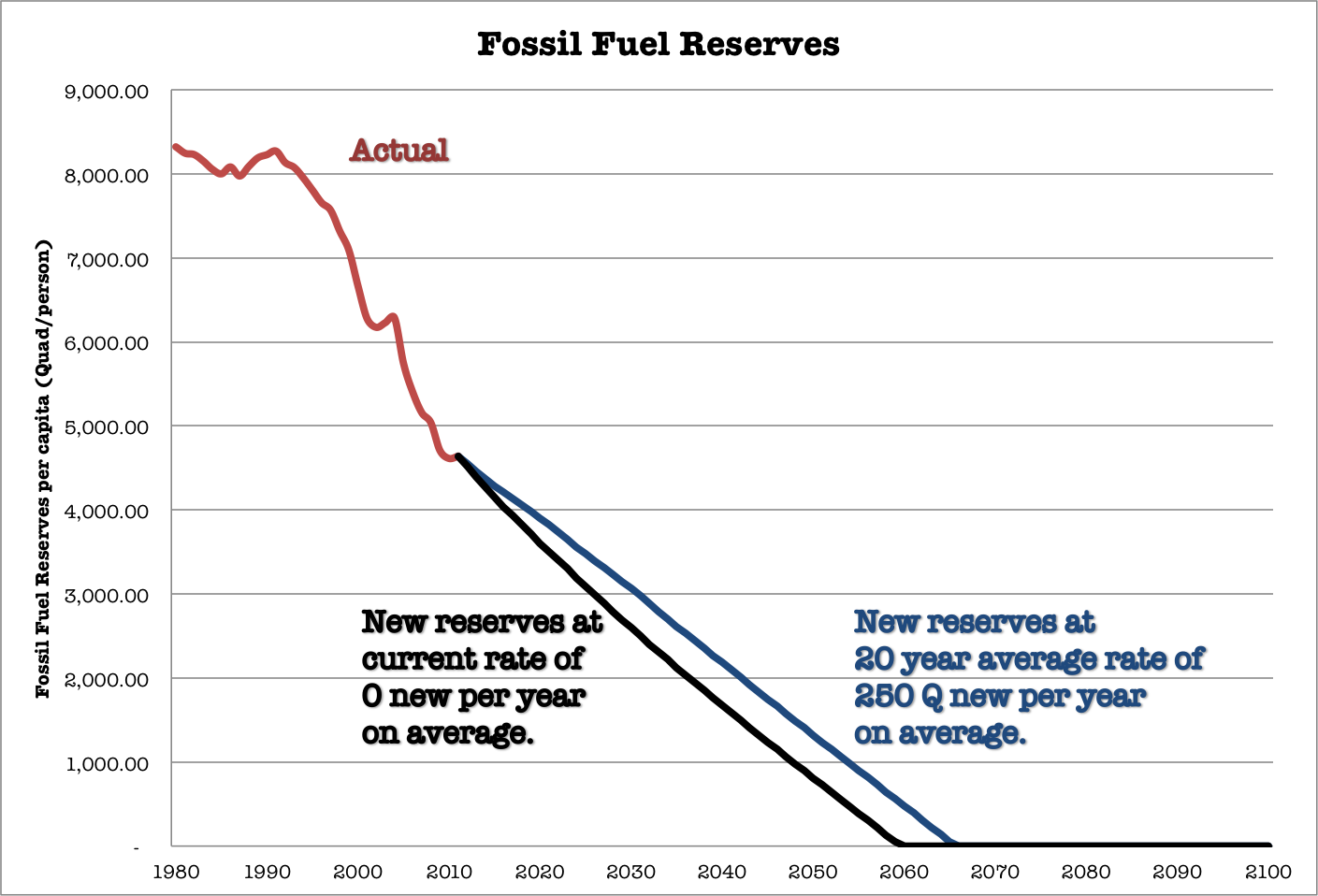
Looking over the trend of reserves per capita over the past thirty-two years, (other than an outlier due to questionable coal reserve reporting in 1998) the last twenty years have seen a decline of around 40%. This trend saw a leveling off starting in 2009, although it cannot yet be determined if this came from increased production due to fracking or decreased consumption from the economic downturn.


The trend in per capita world energy use continues to climb, as does population. The compounding effect of these increases requires that reserve development needs to greatly exceed the rate for the past thirty years in order to keep up with demand. Price increases due to shortages can provide incentive for more development, but may not necessarily cause a fast enough response to make a difference.
It would take an unprecedented change in reserves (or population) to restore us to the peak in 1990. The Peakists are correct that we have reached the peak and past it. Everything we do from here on out determines how fast we proceed to the point where we do not have enough fossil fuel energy to meet our needs.
Let us hope that when that point comes, we have already found a way to live a high quality of life without them.
Subscribe to:
Posts (Atom)